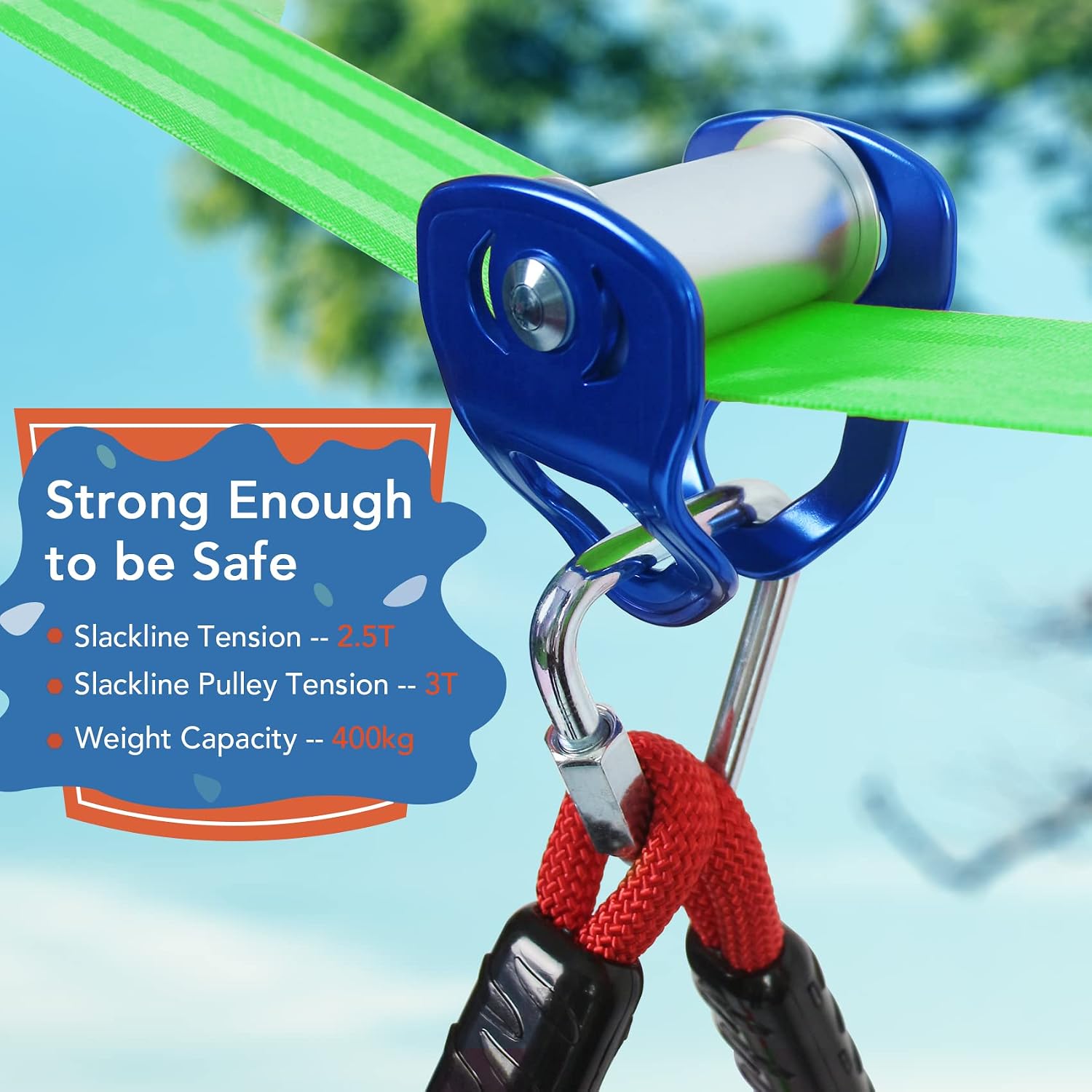
If you’ve spent any time planning a backyard zipline, you already know that a single cable strung between two trees is only the beginning. More and more builders — especially those with enough property to stretch a meaningful span — are starting to treat their outdoor space less like a “zipline installation” and more like an adventure circuit: a connected series of physical challenges that keeps riders engaged before and after the zip itself. A ninja obstacle course is a sequence of hand-over-hand, balance, and climbing challenges (monkey bars, hanging rings, rope ladders, balance beams) that you can string between anchor trees or dedicated posts. A slackline — a flat webbing strap tensioned between two points — adds a balance-walking element. When these three systems share the same footprint, the result is genuinely more fun per square foot than any of them delivers alone. This guide is for builders who are past the “should I do this?” stage and into the “how do I do this without creating a structural or safety mess?” stage.
Why Combos Make Sense — and Where They Go Wrong
The appeal is obvious: riders queue through the ninja course, hit the zip, and land at a soft-stop zone. A well-designed combo loop means nobody is standing around waiting. But the integration problems are real, and they tend to cluster around three failure modes that experienced builders run into.
Shared anchors carrying mismatched loads. A zipline cable under tension is a static, predictable load. A kid swinging through monkey bars generates dynamic load — force spikes that can be two to four times the rider’s body weight, created by sudden direction changes. If your zipline anchor tree is also the end-post for your ninja course, you are stacking those two load types on the same attachment point. Per ASTM International’s Standard F2291, dynamic loads on recreational structures must be calculated separately from static tension loads and then combined — they do not simply add. Most backyard builders skip this step and assume the tree “is fine.” Sometimes it is. But a tree that is perfectly healthy for a 300 lb static zipline load may not be appropriate for an additional 400–600 lb dynamic spike from a swinging adult.
Clearance zones that overlap. Every zipline needs a clearance envelope — the three-dimensional space that must stay free of obstacles while a rider is in motion. Ninja course elements (overhead rings, hanging rope sections) are often strung from the same structural line that the zip runs along, and they encroach on that envelope. SaferParks’ incident data consistently shows that secondary-structure contact — a rider’s foot catching a dangling rope — is one of the most common causes of mid-span incidents on combined installations.
Brake system geometry that changes when you add weight stations. If your zipline’s brakeline (the secondary cable or bungee that slows the trolley before the end anchor) was sized for a single-rider run on a clean span, adding a staging platform mid-span — even a lightweight one for a ninja course transition — changes the effective run length and rider approach speed. The brakeline needs to be re-evaluated any time you modify the span geometry.
Planning the Layout: Sequence and Separation
The most important layout decision is which comes first — the ninja course or the zip — and how much physical separation you build between the two activity zones.
Option A: Ninja course feeds into the zipline launch platform. Riders complete the obstacle run, climb to a platform, and zip. This is the most common configuration and the cleanest from a clearance standpoint because the ninja course terminates before the zipline envelope begins. The tradeoff: your launch platform needs to be structurally independent of the ninja course framing, which adds cost and complexity. If you try to save money by using the same posts for both, you are back to the shared-anchor load problem above.
Option B: Zipline runs parallel to the ninja course, with a shared landing zone. The zip and the obstacle course are side-by-side but spatially separate. Riders choose their challenge or do both in sequence. This requires more horizontal space — plan on at least 10 feet of lateral separation between the zip cable and any overhead ninja course element — but it keeps the structural loads cleanly isolated. ACCT’s Challenge Course Standards recommend a minimum lateral separation of 1.5 times the maximum swing radius of any adjacent element, which for a standard 8-foot monkey bar run works out to roughly 12 feet of clearance.
Option C: Multi-element integration with a mid-span transition. This is the advanced build: the ninja course, slackline, and zip are connected in a single continuous circuit with a mid-span rest platform. It requires purpose-built structural posts (not trees), a professional load analysis, and almost certainly a site inspection under your local building permit process. If you are reading this as a camp director or eco-resort developer, this is where you are likely headed — and the ACCT vendor inspection process, combined with Petzl or Rock Exotica hardware at every critical attachment point, is the right framework.
Hardware Matching Across Systems
Once your layout is settled, the hardware decisions become more tractable — but the intermediate builder’s instinct to mix-and-match components from different tiers is exactly where things go sideways.
By the Numbers
| System Element | Typical Static Load Rating Needed | Dynamic Load Multiplier | Minimum WLL (Working Load Limit) to Specify |
|---|---|---|---|
| Zipline trolley attachment | 1× rider weight + cable tension | 1.5–2× | 3× rider weight |
| Ninja course overhead anchor | 1× rider weight | 2–4× (swing/impact) | 5× rider weight |
| Slackline anchor | Tensioning force (variable) | 1.5× | 4× rider weight |
| Shared structural post | Sum of all attached elements | Worst-case combined | Engineer-specified |
WLL = Working Load Limit, the manufacturer-rated maximum safe working load. Never confuse WLL with breaking strength — breaking strength is typically 5× WLL for recreational hardware.
Trolleys and hangers. A Zip Line Gear trolley or equivalent stainless-bearing unit is appropriate for the zipline segment. For ninja course overhead traverses, you want purpose-made gymnastics or challenge course hangers with rated attachment points — not modified carabiners or hardware-store hooks. Petzl’s technical notices are explicit that their zipline-specific hardware (the SPIN L2 and related systems) is rated for zipline geometry and not for the pendulum forces generated by traversal elements.
Cable gauge on a combo build. If your zipline is already running 5/16” stainless steel cable, that cable is not the right choice to also tension your slackline (slacklines use flat webbing or dynamic rope, not wire cable) or to support hanging ninja course elements without separate attachment infrastructure. Each system needs its own dedicated structural line.
Brake matching revisited. On a combo build where the zip launch platform is elevated above the ninja course ground level, the effective drop angle of your zipline increases. A steeper angle means higher approach speed at the braking zone. If you designed your brakeline geometry for a 2% slope and your new platform adds 18 inches of elevation to the launch, you may now be running effectively at 3–3.5%. Per published guidance from AnytimeZiplines’ component specification resources, each additional percentage point of slope increases terminal speed by roughly 15–20% on spans over 100 feet. Size your brake accordingly — or, if you are running an inline brake (a friction-based device clamped to the cable that engages automatically at the end of the run), verify with the manufacturer that the model is rated for the new speed range.
Slackline Integration: The Overlooked Third Element
A slackline — typically 2-inch flat nylon or polyester webbing tensioned between two anchor points — is often an afterthought in combo builds, but it is worth treating as a first-class structural element. A properly tensioned slackline generates horizontal anchor forces that can exceed 500–800 lbs at standard recreational tension levels, even for lighter riders. If you are anchoring the slackline to the same trees that carry your zipline, those anchor loads combine.
The good news: slacklines are self-contained and physically unobtrusive. A 30–50 foot slackline run positioned 10–15 feet uphill from the zipline landing zone works well as a “warm-up” element and keeps anchor loads spatially isolated. Use ratchet-style tensioners with published WLL ratings (most quality consumer slackline kits from brands like Gibbon Slacklines publish these in their product specs), and protect tree bark with wrap guards at every anchor point — both for tree health and to prevent the webbing from cutting into bark under tension, which degrades both the anchor and the tree over time.
Decision Framework: If X, Then Y
You have read the tradeoffs. Here is how to translate them into a build decision.
If you are a family builder adding a ninja course to an existing backyard zip (span under 100 feet, max rider weight under 150 lbs): Keep the systems on separate structural anchors. Use dedicated ninja course posts (4×4 or 6×6 pressure-treated lumber, set in concrete) rather than loading the zipline trees with additional dynamic forces. A parallel layout (Option B above) is your lowest-risk path. Budget $300–$600 for the ninja course framing and hardware on top of your existing zip investment.
If you are an intermediate DIY builder specifying a longer span (100–250 feet) with adult riders: You need a written load analysis before combining systems on shared anchors. A structural engineer consultation runs $200–$500 and is the single best investment you can make. Specify all hardware at WLL ≥ 5× maximum expected rider weight, use inline brakes rated for your calculated approach speed, and maintain strict lateral separation between zip and obstacle elements per ACCT guidelines.
If you are a camp director or commercial operator: Option C (integrated multi-element circuit) is achievable but requires ASTM F2291-compliant design documentation, ACCT vendor inspection, and institutional-grade hardware from Petzl, Kong, or Rock Exotica at every critical attachment. Budget $3,000–$8,000+ for a professionally designed combo circuit at this scale, and plan for annual inspection costs. The SaferParks database shows that commercially operated challenge courses with documented annual inspections have substantially lower incident rates than those without — the inspection cost is not optional overhead, it is part of the product.
The backyard adventure circuit is one of the most rewarding builds you can take on as a property owner or facility manager. The families and campers who run the full loop — obstacle course, slackline, zip, landing — come back for it in a way they simply don’t for a standalone swing set. Getting the integration right just requires being honest about what each system demands structurally, and making sure those demands don’t quietly stack up on an anchor that was never designed to carry all of them at once.