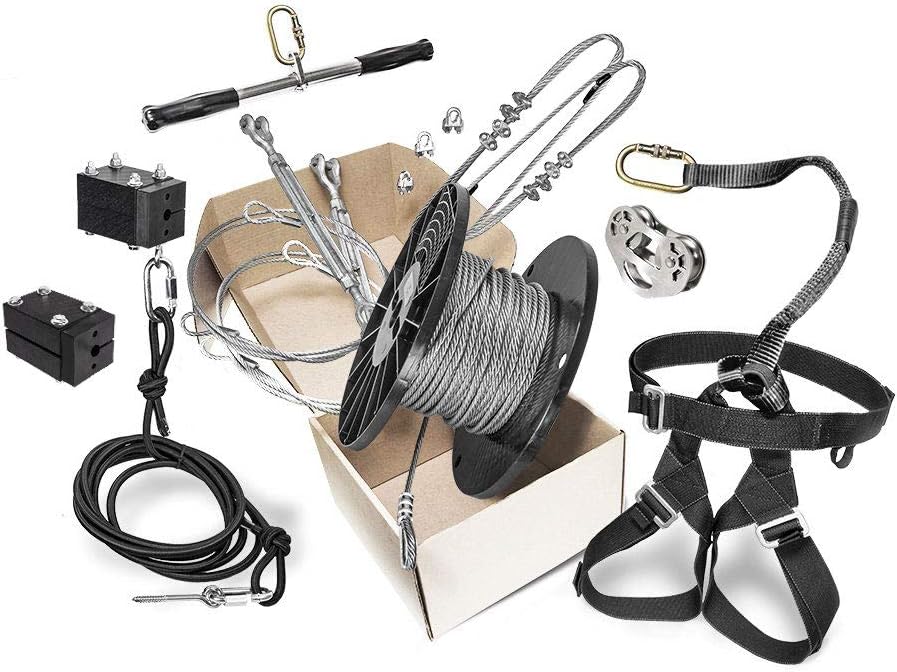
You’ve outgrown the $150 kit from the big-box store — maybe the cable stretched, the brake felt vague, or you simply want a longer run with real stopping power. A custom-configured zipline means you’re sourcing each component individually: the steel cable (the wire rope that forms the ride path), the trolley (the wheeled carrier that rides the cable and holds the rider’s harness or handle), the brake system (the hardware that slows and stops the trolley safely), and the anchor hardware at each end. Done right, this approach puts you in the $500–$1,500 range and produces a ride that can handle adult riders, spans up to 300 feet, and last a decade with basic maintenance. Done wrong, it’s an expensive pile of mismatched parts. This guide is a decision-by-decision framework for getting it right — with the tradeoffs named explicitly and the math shown.
The Decision Stack: Why Order Matters
Most build mistakes happen when builders buy the trolley they like the look of, then try to make everything else fit around it. The right order is the reverse:
- Lock your span and slope first. Every component specification flows from these two numbers.
- Choose cable gauge to match load and span.
- Select a trolley rated for your riders.
- Match the brake system to your speed at bottom of run.
- Specify anchor hardware to match your cable tension and site.
Miss that order and you’ll end up with a brake rated for 150 feet on a 280-foot run, or 3/8-inch cable hardware on 1/4-inch wire. Both are real failure patterns flagged in SaferParks’ Zip Line Safety Data Summary.
Cable: The Decision Most Builders Under-Specify
Wire rope — the steel cable that forms the zipline path — looks interchangeable until you understand what differentiates it. For spans in the $500–$1,500 custom build range, you’re almost always choosing between 3/8-inch 7×19 galvanized steel and 3/8-inch 7×19 stainless steel. The numbers mean: 7 bundles of 19 individual wires, twisted to form the rope.
Galvanized vs. stainless: Galvanized cable runs $0.50–$0.85 per foot (2026 supplier pricing from AnytimeZiplines and SkyHighZiplines product catalogs). Stainless runs $1.40–$2.20 per foot. The performance difference is almost entirely about corrosion life. In a dry inland climate, galvanized is a reasonable choice and gets re-coated with cable lube annually. In coastal, humid, or high-rainfall environments, operators and long-run owners consistently report that galvanized shows surface rust within 2–4 seasons; stainless is the only sensible pick for longevity.
Breaking strength vs. working load: A 3/8-inch 7×19 galvanized cable carries a published breaking strength around 14,400 lbs. The working load limit (WLL) — the load you should actually put on it — is typically that figure divided by a safety factor of 5 to 7. ACCT’s Standards for Challenge Courses and Canopy/Zip Line Tours, 13th Edition, requires a minimum 5:1 design factor for structural components; most residential builders and commercial operators should target 7:1 for any rider-contact line. At 7:1, your 14,400-lb rope supports a working load of roughly 2,057 lbs — plenty of margin for a single adult plus dynamic load.
Where builders go wrong: Using 1/4-inch cable to save money on a 200+ foot span. Quarter-inch 7×19 galvanized breaks at roughly 6,100 lbs, giving you a 7:1 WLL of just 870 lbs. Add dynamic loading — the spike in force as a rider hits the brakeline — and you’re eating into margin fast. Stick with 3/8-inch for any span over 100 feet or any adult-rated installation.
By the numbers — cable cost for a 200-ft run:
- 3/8” galvanized, 220 ft (adding 10% for terminations): ~$165–$187
- 3/8” stainless, 220 ft: ~$308–$484
- Budget difference: $120–$300 — cheap insurance if you’re near water or in the Southeast
Trolleys: Matching the Carrier to the Rider and the Cable
The trolley is what actually rides the cable, so its wheel groove must match your cable diameter exactly. A trolley spec’d for 3/8-inch cable on a 1/2-inch cable will wobble and accelerate unpredictably. A 1/2-inch trolley on 3/8-inch cable will chatter and wear fast.
Wheel material matters more than most builders expect. Cast iron wheels are the budget option — they’re hard, don’t compress, and wear cable over time on high-cycle installations. Aircraft-grade aluminum wheels or nylon-coated steel wheels reduce cable wear substantially. Zip Line Gear’s stainless trolleys and Kong’s zipline trolley systems both use designs that owners in multi-year reviews consistently describe as quiet and low-maintenance; the published specs on Kong’s models include corrosion-resistant stainless sheaves that the manufacturer rates for multi-thousand-cycle commercial use.
Weight rating is the number you cannot fudge. Petzl’s Technical Notice on zipline equipment is explicit: rider weight plus equipment weight plus dynamic load factor must fall within the component’s rated capacity at the required safety factor. A trolley rated for 250 lbs doesn’t mean your 220-lb rider is fine — you need to add harness weight (~5 lbs), the dynamic load multiplier (ACCT standards suggest planning for 2–3× static weight in worst-case arrest scenarios), and any margin for multi-rider tandem configurations.
Practical tier guidance:
- Under $150 rider, 50–150 ft span: Mid-grade aluminum trolley from Zip Line Gear or similar — available in the $45–$85 range, rated 250 lbs, adequate for residential use.
- Adult riders, 150–300 ft: Step up to a commercial-grade trolley (Kong, Petzl, or Rock Exotica category) rated 300–400+ lbs with stainless hardware. Budget $90–$180 for the trolley alone.
- Multi-rider or camp/commercial use: Rock Exotica and Kong publish documentation for their trolleys specifically referencing ASTM F2959 compliance — that’s the ASTM standard for aerial adventure courses. If you’re running a camp or eco-resort, ASTM F2959 compliance on every rider-contact component isn’t optional; it’s what your insurance underwriter will ask for.
Brake Systems: The Most Consequential Spec Decision
This is where the build either earns its money or fails. The brake system has one job: arrest the trolley and rider before they hit the end anchor, at whatever speed they’re traveling at the bottom of the run. Getting this wrong is the single most cited cause of zipline injuries in the SaferParks dataset.
Passive vs. active brakes: A passive brake uses friction — a bungee brakeline, a spring-loaded mechanism, or a rubber disk — to slow the trolley over the last segment of cable. An active brake (or assisted brake) uses a controlled mechanical system, sometimes gravity-assisted, to progressively slow the rider. For spans under 150 feet at moderate slope (7–12% grade), a properly configured bungee brakeline is adequate for recreational use. For anything longer or steeper, you need a mechanical inline brake.
Inline brakes — what the spec means: An inline brake clamps around the cable and uses friction between a braking element and the wire rope to decelerate the trolley. The key spec is the braking force curve — how quickly it engages, and over what distance it arrests the rider. A brake that engages too hard too fast produces whiplash forces; one that engages too softly doesn’t stop the rider in time. Manufacturers like Zip Line Gear (their ZipStop product line) and SkyHighZiplines publish stop-distance figures at rated load — read these against your cable length and the expected speed at the bottom of your run.
Speed estimation: A rough working formula used by builders and referenced in ACCT training materials: terminal speed at bottom of a zipline is approximately proportional to the square root of vertical drop. A 200-foot run with 20 feet of vertical drop will hit roughly 14–17 mph at the bottom under typical conditions. A 300-foot run with 40 feet of drop can reach 22–27 mph. Your brake must be rated for that speed at your maximum rider weight, with margin.
If X, then Y — brake decision rules:
- Span ≤ 150 ft, max rider 150 lbs, slope < 10%: bungee brakeline at $20–$40, re-tensioned every season.
- Span 150–250 ft, adult riders, any slope: mechanical inline brake — budget $80–$150, spec to 300 lb minimum rated load.
- Span 250 ft+, commercial or camp use: redundant braking — mechanical inline brake plus a secondary arrest bungee — minimum $150–$250 in brake hardware, ASTM F2959 inspection annually.
Anchor Hardware and Tensioning: The Part Builders Rush
Every zipline has two anchor points — a launch end (top) and an arrest end (bottom). Each anchor must resist the combined cable tension (the static force keeping the cable taut) plus dynamic loads from riders. A poorly specified anchor is silent until it fails.
Cable tension and sag: Sag is the downward curve of the cable under its own weight between anchors. A cable tensioned too tight has low sag but puts enormous strain on anchors; too loose and riders slow to a crawl mid-run or, worse, there’s not enough clearance between the rider and the ground at the low point. The standard design target for residential ziplines per ACCT and widely-cited builder guidance is 4–6% sag (cable length at rest divided by horizontal span). At that tension, a 200-foot span will carry roughly 800–1,200 lbs of horizontal tension force on each anchor — meaning your anchor hardware must be rated well above that figure.
Hardware minimum spec: Use swaged or mechanically pressed cable fittings (end stops where the cable is permanently formed around a fitting) rather than cable clamps wherever possible. Cable clamps are acceptable but require exact torquing per manufacturer spec and periodic re-inspection. A swaged thimble-and-turnbuckle assembly at $30–$60 per end is more reliable. Your turnbuckle (the adjustable tensioning fitting that lets you dial in sag) should be rated to at least twice your expected cable tension — a 3,000 lb-rated turnbuckle is the right floor for 3/8-inch cable installations.
Tree anchors deserve a separate mention. The CPSC’s Public Playground Safety Handbook and ACCT standards both note that live tree anchors require professional assessment; trees move, grow, and their root systems change anchor geometry over years. Use a tree saver strap (a wide nylon sling that distributes load without cutting bark) rated to match your cable tension, and plan to re-inspect annually.
Putting the Budget Together
A well-specified $500–$1,500 build for a 200-foot adult-rated residential zipline breaks down roughly as follows:
| Component | Budget Range |
|---|---|
| 3/8” stainless cable, 220 ft | $310–$490 |
| Commercial trolley (Kong or Rock Exotica tier) | $90–$180 |
| Inline brake system | $80–$150 |
| Anchor hardware (2 ends, turnbuckles, thimbles) | $80–$140 |
| Harness (adult-rated, EN/ASTM certified) | $60–$120 |
| Tree saver straps + shackles | $30–$60 |
| Total | $650–$1,140 |
Going stainless cable with Rock Exotica or Petzl-tier hardware at the top of each range gets you to roughly $1,140 — a serious, inspection-ready build. Choosing galvanized cable and mid-grade (but properly rated) trolley and brake hardware lands closer to $650–$750 without sacrificing structural safety.
The clearest decision rule: if you’re building for adults, spans over 150 feet, or any commercial-adjacent use, don’t try to hit the bottom of this budget. The $150 you save on cable or a trolley is not worth the re-do when a component fails inspection or, worse, fails in service. Spend the money where the load paths are — cable, trolley, and brake — and economize on accessories.