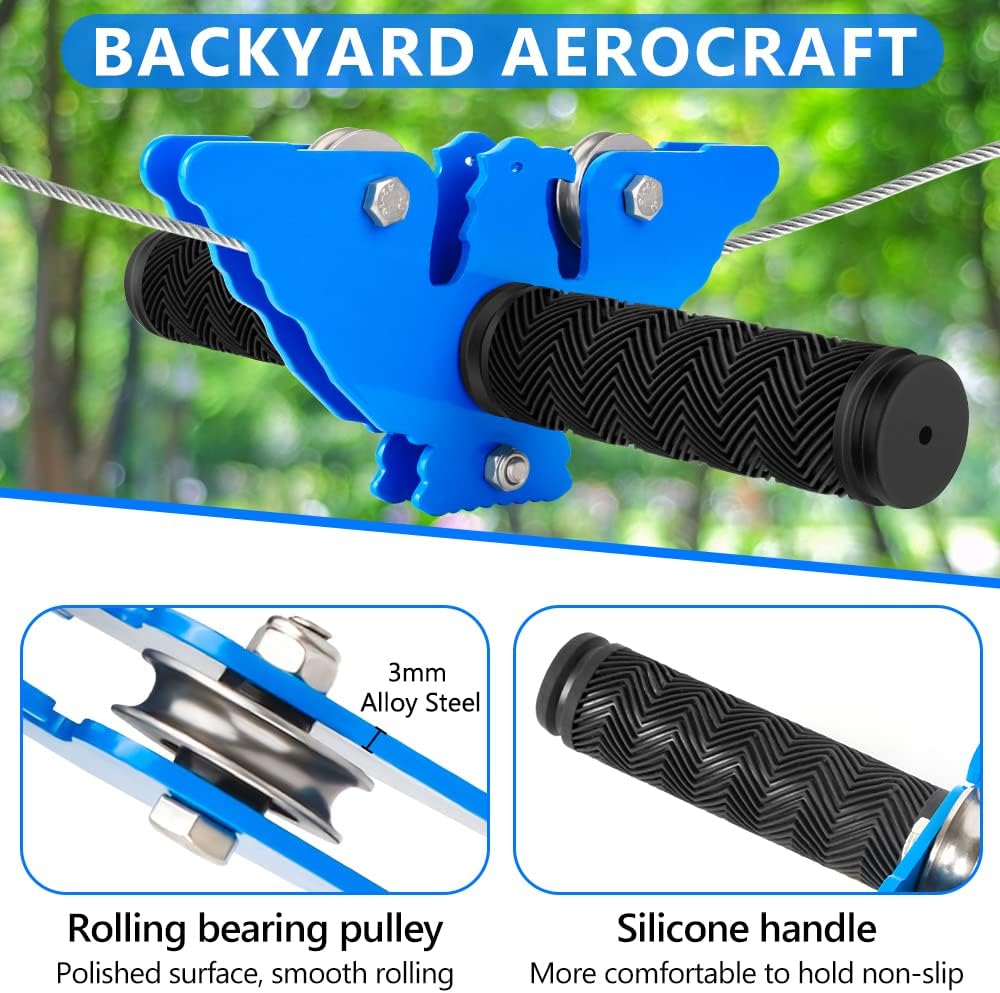
A backyard zipline is exactly what it sounds like: a steel cable strung between two anchor points — usually trees — that a rider slides down on a wheeled trolley (the rolling attachment that carries the seat or harness). Short-span kits, those designed for runs of 65 to 100 feet (roughly the length of two school buses parked end to end), are the most popular entry point for families with kids ages 5 to 12. They’re also the most crowded and most confusing corner of the market, because at the $60–$110 price point, the packaging all looks similar but the engineering underneath varies enormously. This article breaks down the kits that come up most often in that price window — Slackers, ZipKrooz, and SkyWalker — comparing the specs that actually matter, flagging where each one asks you to trust the manufacturer a little more than you should, and giving you a clear decision framework so you can stop second-guessing your cart.
What the Specs Actually Mean at This Price Point
Before comparing kits, it helps to understand which numbers matter and which ones are marketing shorthand.
Cable diameter and construction. Every kit in this tier uses galvanized (rust-resistant zinc-coated) steel cable, typically 5/16-inch (roughly 8 mm) diameter. That diameter is appropriate for short residential spans under 100 feet — the engineering consensus from ACCT’s zipline best-practices documentation supports 5/16-inch as the minimum acceptable gauge for single-rider recreational spans at these lengths. What the packaging rarely tells you clearly is the cable’s strand construction — a 7×19 construction (seven groups of nineteen wires each) is more flexible and fatigue-resistant than 7×7, which matters for the repeated bend stress at your anchor points. Most kits in this tier use 7×7, which is acceptable but worth knowing.
Weight ratings — the number everyone misreads. Manufacturer weight limits in this tier cluster around 150 to 175 lbs. That’s the static load rating, not a dynamic safety factor. When a rider drops into the seat mid-run, the instantaneous load on the cable and trolley can be 2–3× their body weight. ASTM F2957 — the consumer zipline safety standard — requires that zipline components withstand a minimum 4:1 safety factor over the rated working load. In plain terms: a kit rated for 150 lbs should, under that standard, be built to handle at least 600 lbs of force without failure. Whether any given $80 kit actually achieves that in its trolley and end hardware is something spec sheets don’t always confirm clearly. The safe operating practice is to treat the stated weight limit as a ceiling, not a suggestion — and to apply it conservatively if you have a heavier adult who might “just try it once.”
Span length claims. When a kit says “up to 100 feet,” that typically means the cable is long enough for a 100-foot run before sag correction. Cable sag — the natural droop of a cable under tension — means you need to anchor the high end higher than you might expect. A rough field rule (supported by the CPSC’s playground equipment guidance) is to plan for 1 foot of sag per every 50 feet of horizontal run on a moderately tensioned residential setup. Ignore sag and your rider reaches the low end with more speed than the kit’s brake system can handle safely.
Kit-by-Kit Breakdown: Slackers, ZipKrooz, SkyWalker
Slackers Zipline Kits ($75–$110 range)
Slackers (branded under Outdoor Products Inc.) are the most widely reviewed kits in this tier — they appear consistently at major outdoor and toy retailers, and aggregated owner reviews across retail platforms place them near the top of the budget category for hardware durability. Published specs on the 70-foot and 90-foot Slackers kits list a 150-lb weight limit and include a pulley-style trolley with a bungee-cord brake attached to the lower anchor tree.
The bungee brake deserves scrutiny. A bungee (elastic cord) brake works by stringing a cord horizontally across the cable’s path; the rider’s trolley strikes the bungee and decelerates. It’s a proven low-cost mechanism, but its stopping power is fixed at the time you string it up. On a 90-foot span with good grade (a steep angle between anchor points), riders approaching the lower end can be moving faster than the bungee is calibrated to stop comfortably. Owners consistently report that the bungee brake is adequate for younger, lighter riders (under 80 lbs) but starts feeling “abrupt” for older kids near the 100–125 lb range, particularly on spans strung at steeper-than-recommended angles. The fix — buying a separate spring brake or inline brake — costs another $30–$50 and is worth budgeting for at the start.
Bottom line on Slackers: The hardware quality (cable clamps, trolley wheel material) is better documented than most competitors in this price window, and the owner review volume gives you real-world signal. It’s the least risky choice if you’re specifying a first kit and want evidence behind your decision. The bungee brake is its one honest limitation.
ZipKrooz ($80–$105 range)
ZipKrooz kits from Backyard Discovery target the same span range and age group with a design emphasis on the seat rather than the cable hardware. Their enclosed seat (a molded plastic shell that surrounds the child rather than an open T-bar) gets consistent positive marks from parents of younger children (ages 5–8) who worry about a child letting go mid-run.
Published specs put the ZipKrooz at a 125-lb weight limit — notably lower than Slackers — which is an honest constraint to respect. The trolley wheel is nylon rather than the steel-reinforced nylon found in higher-tier products; across aggregated reviews, owners in their second season of use report more wheel wear than they saw with competing kits, particularly in dusty or gritty environments where abrasives accelerate nylon degradation.
The ZipKrooz brake system is similar to Slackers’ bungee approach. On a 65–75 foot span — the shorter end of the range — it performs reliably for kids under 100 lbs. For spans pushing toward 90–100 feet with older or heavier riders, the lower weight rating makes ZipKrooz a tighter fit than the packaging suggests.
Bottom line on ZipKrooz: It’s the right call if your riders are on the younger, lighter end (under 90 lbs consistently) and the enclosed seat is a priority for your peace of mind. It’s the wrong call if you’re planning for kids who will grow into it over two to three seasons or who are already approaching the upper weight limit.
SkyWalker Zipline Kit ($60–$90 range)
SkyWalker is the most aggressively priced option in this tier and the one that generates the most polarized owner feedback. Published specs claim a 150-lb weight limit and a 90-foot cable, and the kit price undercuts Slackers by $15–$25 at most retailers.
The consistent pattern in owner reviews: the cable and seat hardware are comparable to Slackers at purchase, but the included tensioning hardware — the devices you use to pull the cable taut between your trees — is lighter-gauge than competing kits, and owners report more difficulty achieving adequate tension on spans above 75 feet. Insufficient cable tension directly increases sag, which (as noted above) increases rider speed at the lower end and puts more stress on the brake system. SkyWalker’s own installation documentation, per their 2025 product guides, specifies a maximum recommended grade of 3% (about a 3-foot drop for every 100 feet of horizontal run) — at the shallower end of the range, which partially compensates for the tensioning hardware limitations.
Bottom line on SkyWalker: The value is real if your installation site is naturally gentle (low grade, under 75-foot span, lighter riders). It’s a riskier specification choice on longer or steeper spans where tensioning hardware quality directly affects safety.
By the Numbers
| Kit | Price Range | Weight Limit | Cable Length | Brake Type | Best Fit |
|---|---|---|---|---|---|
| Slackers | $75–$110 | 150 lbs | 70 or 90 ft | Bungee | Best all-around; most reviewed |
| ZipKrooz | $80–$105 | 125 lbs | 70 ft | Bungee | Younger/lighter kids; enclosed seat |
| SkyWalker | $60–$90 | 150 lbs | 90 ft | Bungee | Gentle-grade installs under 75 ft |
The Variables That Override Kit Choice
Even a well-chosen kit becomes a safety problem if the installation environment isn’t accounted for. Here are the three variables that matter more than which kit you order.
Tree health and anchor point integrity. The CPSC’s playground safety documentation is explicit: hardware failure in residential ziplines most commonly occurs at anchor points, not on the cable itself. A tree with visible decay, hollow sections, or a trunk under 8 inches in diameter is not a reliable anchor for any kit in this tier, regardless of what the installation guide says. When in doubt, consult a certified arborist before you string cable.
Grade and sag calculation. Use the 1-foot-of-sag-per-50-feet rule as a minimum estimate and add anchor height accordingly. ACCT’s operational guidelines recommend a minimum ground clearance of 2 feet at the cable’s lowest point (mid-span, where sag is greatest) for spans in this length range. For a 90-foot span with 18 inches of sag, your cable at mid-span needs to be at least 3.5 feet above the ground — which means your high anchor needs to account for that geometry, not just the endpoint height.
Brake placement and adjustment. Every kit in this tier relies on a bungee brake attached to the lower tree. The bungee needs to be positioned so it engages the trolley at least 6 feet before the anchor, giving deceleration distance before the rider reaches the tree. Owners who skip this step and place the bungee at the tree itself report abrupt, jarring stops — which is exactly what “works as designed” looks like when the geometry is wrong.
The Decision Framework
If your span is under 75 feet and your riders are under 90 lbs: any of the three kits is a reasonable specification. SkyWalker’s cost advantage is real and the lower-grade installation fits its tensioning hardware limits. Budget the $10–$15 price difference toward an extra bungee or a tree-wrap anchor protector.
If your span is 75–90 feet or your riders are 90–130 lbs: Slackers is the clearest recommendation at this price tier, based on the weight of owner experience and better-documented component specs. Add a spring brake ($30–$50 aftermarket) and treat it as part of the kit cost rather than an optional upgrade.
If your riders are approaching 130–150 lbs or you’re planning for multi-season use as kids grow: you’ve outgrown this tier. The honest answer is to look at intermediate kits in the $200–$350 range — steel-wheeled trolleys, rated steel end hardware, and brake systems that can be adjusted as span geometry changes — rather than trying to stretch a $90 kit beyond its engineering envelope.
The kits in this tier are genuinely good for what they’re designed to do: give kids ages 5–10 a thrilling, manageable backyard ride on a short, modestly-graded span. The ratings above are honest because the limitations are predictable — and predictable limitations are ones you can design around.