Every zipline cable sags. That’s not a flaw — it’s physics. When you string a steel cable between two trees or poles, gravity pulls the middle of it downward, creating what engineers call sag (the vertical drop from a perfectly straight line between your two anchor points). The amount of sag is directly controlled by how much tension you put on the cable. Too little tension and the rider drops so low they scrape the ground or lose momentum; too much tension and you’re placing enormous lateral force on your anchor trees, risking structural failure. Getting the tension right is arguably the single most consequential step in building a safe, functional zipline — and it’s the step where DIY builders most often wing it. This guide explains the three main tools for tensioning zipline cable — turnbuckles, ratchet straps or come-alongs, and dedicated cable pullers — so you can choose the right one for your span, understand the tradeoffs, and dial in your setup with numbers rather than guesswork.
| EDITOR'S PICK[Mytee Products Wire Rope Steel…](https://www.amazon.com/dp/B0753LDWYK?tag=greenflower20-20) | Mid-tier1/2" Heavy Duty Turnbuckle Ultr… | Budget pickOpen-Body Stainless Steel Eye &… | |
|---|---|---|---|
| Type | Wire rope winch cable | Turnbuckle | Turnbuckle |
| Thickness | 3/8" | 1/2" | 5/16" |
| Length | 50' | — | 3-1/4" |
| Breaking/Load | 14,400 lbs | 2,205 lbs WLL | — |
| Material | Steel core wire rope | — | T316 Marine Grade stainless steel |
| End Type | Swivel hook | Jaw & Jaw | Eye & Eye |
| Price | $104.99 | $31.99 | $13.95 |
| See on Amazon → | See on Amazon → | See on Amazon → |
Why Cable Tension Matters More Than Most Builders Realize
Before getting into hardware, it helps to understand what’s actually happening mechanically when you tension a cable. The relationship between tension and sag is non-linear and counterintuitive: pulling a cable from, say, 3% sag down to 1% sag doesn’t require twice the force — it can require five to ten times as much, because you’re fighting the geometry of the catenary curve (the natural shape a hanging cable takes under its own weight).
The Wire Rope Technical Board’s Wire Rope Users Manual makes this explicit: as sag percentage drops below 2%, the tension required to achieve further reductions increases dramatically, and the lateral (horizontal) load transferred to anchor points grows proportionally. For a 100-foot span with a 150-lb rider, the ACCT’s Standards and Practices Manual notes that anchor loads can easily reach 1,500–2,500 lbs under dynamic riding conditions — numbers that your anchor trees, hardware, and cable terminations all need to be rated to exceed with a meaningful safety margin (typically 5:1 for recreational installations, per ACCT guidance).
The practical takeaway: don’t chase the tightest cable you can manage. A target sag of 2–3% of span length is the working range for most backyard and enthusiast ziplines. On a 150-foot run, that’s 3–4.5 feet of center sag. More than that and the ride feels sluggish or bottoms out; less than that and you’re loading your anchors into a range that most backyard hardware isn’t designed for.
By the numbers — sag targets for common span lengths:
| Span Length | 2% Sag | 3% Sag |
|---|---|---|
| 75 ft | 18 in | 27 in |
| 150 ft | 36 in | 54 in |
| 250 ft | 60 in | 90 in |
Measure sag by running a taut string or laser level between your two anchor heights and measuring the vertical drop at the cable’s midpoint.
Turnbuckles: The Workhorse for Most DIY Builds
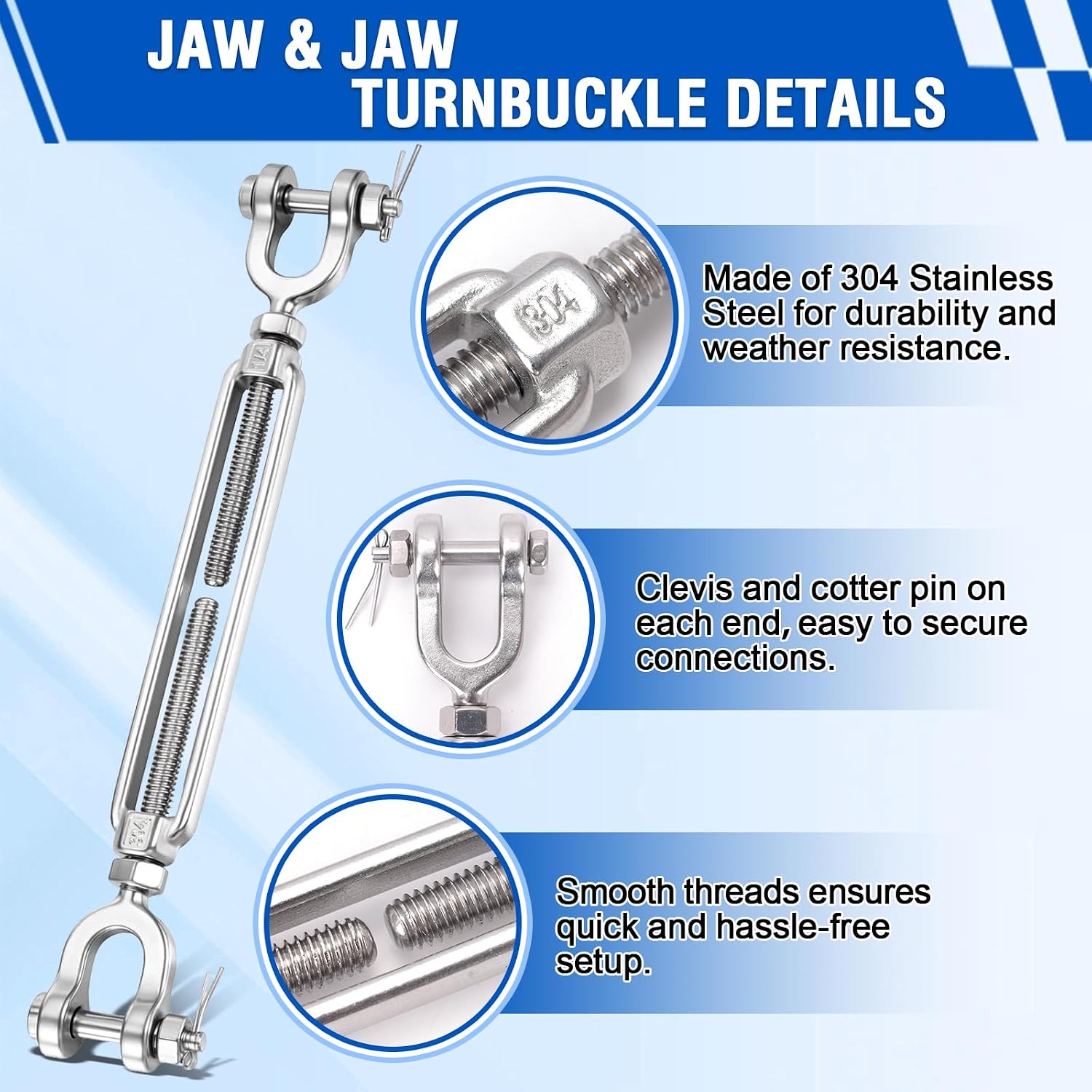
A turnbuckle is a simple mechanical device with two threaded eye bolts or jaw fittings screwed into a center frame. Turning the frame extends or contracts the overall length of the assembly, applying or releasing tension on whatever it’s connected to. On a zipline, a turnbuckle is typically installed between the cable termination (usually a swaged or Crosby-style cable clamp fitting at the anchor end) and the anchor point itself — a wrap-around strap, a lag bolt with a thimble, or a load-rated tree saver strap.
What turnbuckles do well: They’re precise, adjustable after installation, and hold position indefinitely without any stored mechanical energy (unlike ratchet straps). Once set, a turnbuckle doesn’t creep. For spans up to 150 feet with cable gauges of 3/8” or lighter, a properly rated turnbuckle — typically a 5/8” jaw-jaw or eye-jaw galvanized or stainless steel unit with a working load limit (WLL) of 2,800–3,500 lbs — gives you adequate tensioning range and is the most common solution in the enthusiast builder community.
The critical spec to check: Working load limit, not break strength. Manufacturers publish WLL as break strength divided by a safety factor (usually 4:1 or 5:1). For recreational ziplines, the ACCT recommends all hardware meet a 5:1 safety factor against maximum anticipated load. If your anchor load calculations suggest peak forces of 2,000 lbs, your turnbuckle’s WLL should be at least 2,000 lbs — meaning its break strength is 10,000 lbs.
Where turnbuckles fall short: They’re not tensioning tools — they’re tensioning holders. You still need to get your cable close to target tension before the turnbuckle can do fine adjustment. On longer spans (200+ feet) or heavier cable (1/2” diameter), you simply cannot generate enough tension by hand-cranking a turnbuckle alone. You need a mechanical advantage tool to pre-load the cable first.
A lock nut or locking wire through the turnbuckle’s body is non-negotiable after final adjustment. Petzl’s technical documentation on zipline installations specifically flags vibration-induced turnbuckle loosening as a real-world failure mode — owners of permanent installations consistently report that an unlocked turnbuckle will back off over a season of use.
Ratchet Straps and Come-Alongs: Temporary Tensioning Tools
A come-along (also called a hand chain hoist or ratchet lever hoist) is a hand-operated mechanical winch that uses a gear-and-pawl system to pull heavy loads incrementally. A ratchet strap is the lighter-duty cousin — the kind used to strap loads on a trailer. For zipline tensioning purposes, these are almost always used as temporary pre-tensioning tools, not permanent components.
The workflow: attach your cable come-along to the cable near the anchor and haul the cable tight enough to get your sag into target range, then install or tighten the permanent turnbuckle to hold that tension, then remove the come-along. This is standard practice on longer or heavier cable runs where a turnbuckle alone lacks the mechanical advantage to pull sufficient tension.
Sizing the come-along correctly: A 1-ton (2,000-lb) come-along is the minimum practical size for a residential zipline. For spans over 200 feet or 1/2” cable, operators in longer-run reviews note that a 2-ton unit provides meaningfully more control — you’re not working at the edge of its capacity, which reduces operator fatigue and improves precision.
Important limitation: Ratchet straps are generally not appropriate as the sole permanent tensioning component on a zipline. Their webbing can degrade with UV exposure and moisture, and they’re not designed for the sustained lateral loading of a cable under dynamic rider weight. The CPSC’s Handbook for Public Playground Safety cautions against relying on temporary fasteners in load-bearing recreational equipment installations. Use ratchet straps only in the pre-tensioning role, with a rated turnbuckle or mechanical cable termination as the permanent fixture.
Dedicated Cable Pullers: The Right Tool for Serious Spans
For spans over 200 feet, for commercial or semi-commercial installations, or for 1/2” cable (which is heavy and stiff enough that a come-along can feel imprecise), a dedicated cable puller — sometimes called a Gripple tensioner, a cable grip puller, or a wire rope grip — is worth serious consideration.
The category breaks into two main approaches:
Inline cable grips and tensioners (like Gripple brand products): These are small in-line devices that clamp onto the cable without requiring cable termination hardware. They’re widely used in agricultural and commercial fencing and are gaining traction in the zipline builder community for their speed and ease of adjustment. The tradeoff: published specs from Gripple’s own technical sheets put their standard jump range for wire rope at 3/16” to 3/8” — appropriate for light residential lines but not for 1/2” cable runs typical of enthusiast builds. Verify the cable diameter compatibility before specifying.
Mechanical cable pullers (lever or ratchet-style, purpose-built for wire rope): Products in this category — from brands like Klein Tools, Ideal Industries, and the Matheson-brand line — use jaw clamps designed specifically for wire rope (unlike come-along chains, which can deform or slip on smooth cable). For a builder running 3/8” or 1/2” 7×19 or 7×7 galvanized or stainless steel wire rope across a 200–300 foot span, this is the most controlled and safest pre-tensioning approach. Spec sheets for quality units in the 1–2 ton range show cable diameter ratings up to 1/2” and jaw designs that distribute load across the cable cross-section without creating stress risers (localized weak points).
The cost difference is real: a quality cable puller runs $80–$180 compared to $30–$60 for a basic come-along. For a one-time backyard install, the come-along is probably sufficient. For someone configuring multiple spans, a camp doing seasonal setup and teardown, or an eco-resort operator maintaining several lines, the purpose-built tool pays back quickly in time and consistency.
Matching Hardware to Your Build: The Decision Framework
If you’re sitting with a build spec in front of you and trying to decide what to order, here’s the direct version:
If your span is under 150 feet and your cable is 5/16” or 3/8”: A rated turnbuckle (5/8” jaw-jaw, WLL 2,800 lbs minimum, stainless or hot-dip galvanized) plus a 1-ton come-along for pre-tensioning is the standard solution. Owners consistently report this combination handles fine adjustment well through a full season without issues, provided the turnbuckle is locked after final set.
If your span is 150–250 feet or your cable is 3/8” to 1/2”: Upgrade to a 2-ton come-along or mechanical cable puller for pre-tensioning. Keep the turnbuckle as the permanent tension-holder, but move to a 3/4” body turnbuckle with WLL ratings at or above 4,000 lbs. The American Camp Association’s installation guidance for camp ziplines in this span range specifically flags hardware underrating as one of the most common inspection failures.
If your span exceeds 250 feet or you’re building for commercial-adjacent use (camps, resorts, adventure parks): Stop specifying from consumer hardware lists. At this level, ACCT standards essentially require an inspection protocol and documented engineering, and the tensioning hardware needs to be spec’d as part of a complete system — not assembled piecemeal. A professional rigging supplier (Anytimeziplines, SkyHighZiplines, or a regional rigging house) can provide pre-configured tension packages where the turnbuckle, swaged terminations, and cable grip are all matched and documented.
One more thing that applies universally: re-check tension after the first 10–15 rides. New cable stretches — not dramatically, but measurably — as the strands seat and load cycles bed in. The Wire Rope Technical Board’s Wire Rope Users Manual describes this as “constructional stretch” and notes it’s normal for new installations. Budget 30 minutes for a post-break-in tension check and adjustment, and you’ll avoid the disappointment of a line that rode great on day one and feels slack by day three.