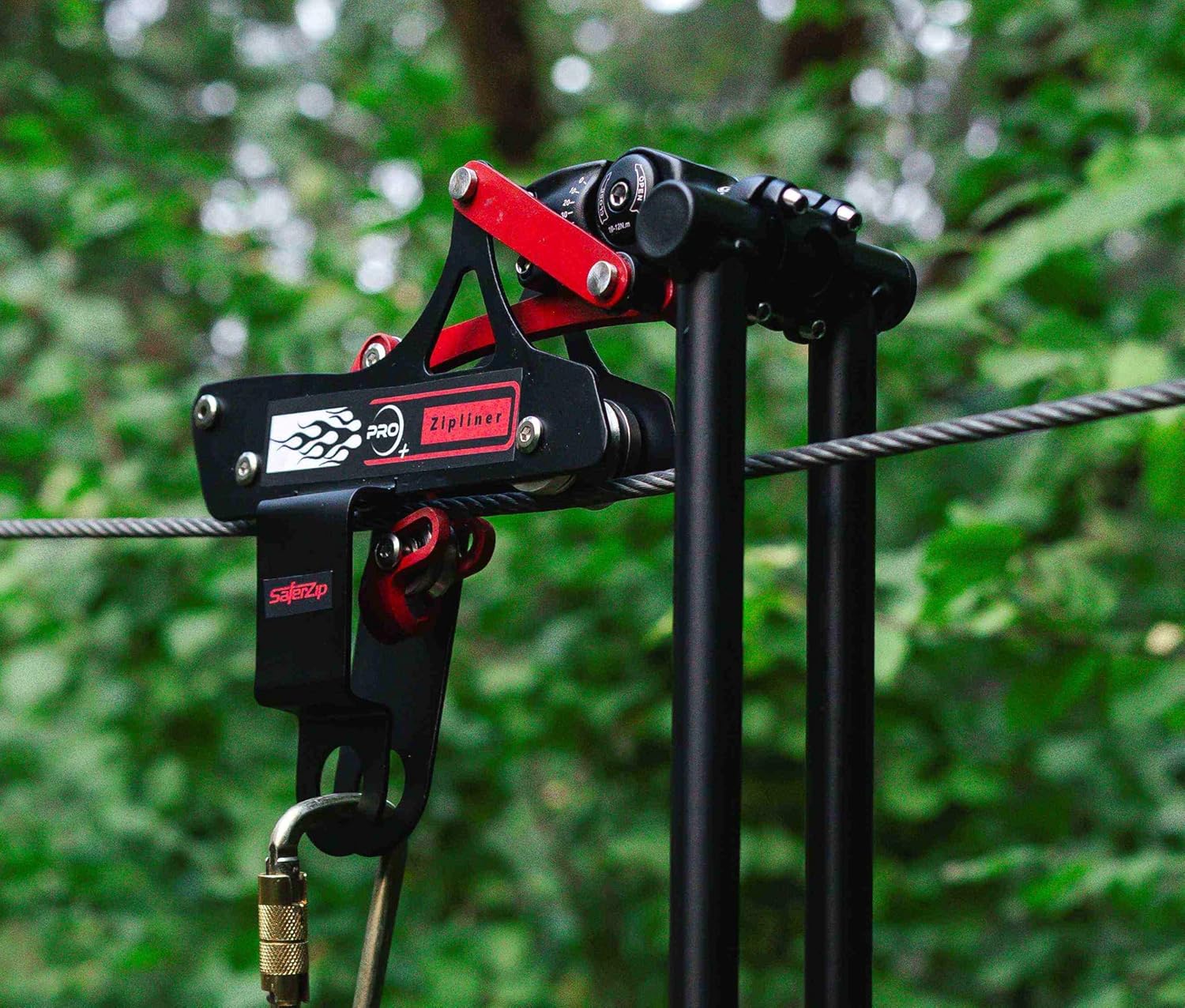
If you’ve ever ridden a zipline and felt the trolley — the wheeled carriage that rolls along the cable — clunking, wobbling, or grinding to a premature stop, you already understand why the trolley is worth thinking hard about. The trolley is the single moving part that takes all of a rider’s weight, speed, and momentum and translates it across a steel cable. Everything else in a zipline system is stationary. This component is not. Choosing the right trolley (and understanding what separates a $25 kit wheel from a $395 professional-grade pulley) can be the difference between a ride that’s smooth, safe, and repeatable for years — and one that wears out fast, limits who can ride, or quietly approaches a failure point you never see coming. This guide walks through every tier of the market, shows you the specific specs that drive the price differences, and gives you a clear decision framework for where your build actually sits.
What You’re Actually Buying: Bearings, Sheaves, and Load Ratings
Before comparing products, it helps to understand three components that drive almost every meaningful difference across the price spectrum.
The sheave is the grooved wheel that contacts the cable. Cheaper trolleys use nylon or glass-filled polymer sheaves; mid-range and professional trolleys use machined aluminum or steel. The groove profile matters: a sheave sized for 3/8-inch cable will skate and wear prematurely on 1/2-inch cable, and vice versa. Mismatched sheave-to-cable sizing is one of the most underreported sources of accelerated trolley wear, per SaferParks incident data covering backyard and camp zipline failures.
The bearing is what the sheave spins on. Entry-level trolleys use either no true bearing (the wheel rotates on a smooth bolt) or open-race ball bearings. Open bearings spin freely when new but collect cable grit, corrode quickly in outdoor environments, and degrade noticeably within a season of regular use. Sealed bearings — enclosed in a protective housing that keeps contaminants out and grease in — are the single biggest functional difference between a kit-grade trolley and a component you’d spec for a commercial installation.
The working load limit (WLL) is the manufacturer-rated maximum load the trolley is designed to handle in normal operation. It is distinct from — and always lower than — the breaking strength. ACCT’s Challenge Course and Zipline Standards (9th Edition) recommends a minimum design factor of 10:1 (breaking strength at least 10 times the anticipated load) for zipline hardware on public-facing installations. For a 250-lb rider, that means you want hardware with a breaking strength of at least 2,500 lbs — a number many entry-level trolleys don’t clear.
The Four Price Tiers, Mapped to Real Builds
Tier 1: $25–$75 — Kit-Grade Trolleys (Nylon Wheel, Open Bearing)
This is what ships inside box kits from Slackers, SkyWalker, and similar brands. Owners of these systems consistently report smooth performance for the first season with lighter riders — kids in the 60–100 lb range on spans under 100 feet. Published weight ratings typically land between 150 and 250 lbs, but those numbers usually reference breaking strength, not a true working load limit with a safety factor applied. ASTM F1148, the consumer standard for home playground equipment, sets baseline structural requirements, but it does not mandate sealed bearings or specify design factors the way ACCT standards do for commercial equipment.
Where this tier makes sense: A first backyard kit for kids ages 5–10, spans under 75 feet, riders under 100 lbs, and a realistic expectation of replacing the trolley every 2–3 seasons. If the total system cost is $100–$200, a $35 replacement trolley is an acceptable maintenance cost.
Where it fails: Adult riders, spans over 100 feet, multi-rider throughput (summer camps, commercial operations), or any installation where the trolley runs dozens of cycles per day. Open bearings on these trolleys typically show measurable degradation — slower roll, lateral wobble — within 200–400 cycles under adult loads, based on aggregated operator reviews on long-run forum discussions and equipment supplier FAQs.
Tier 2: $75–$175 — Enthusiast-Grade (Aluminum Sheave, Semi-Sealed or Sealed Bearing)
This is where the DIY builder market lives. Products in this range — including the Zip Line Gear standard trolley and AnytimeZiplines’ mid-tier offerings — step up to aluminum sheaves and at minimum semi-sealed bearings. Working load limits at this tier are typically published explicitly and run from 250 to 400 lbs. Sheave profiles are usually specified for a single cable diameter (most commonly 3/8-inch), so matching to your cable gauge matters here.
Owners in this tier consistently report a noticeable smoothness improvement over kit wheels — the aluminum sheave on steel cable rolls with less resistance and handles higher speeds without heating up the way nylon does on long, fast spans. For backyard builds serving adult riders (150–220 lbs) on spans of 100–250 feet, this tier represents the best performance-per-dollar.
By the numbers — Tier 2 snapshot:
| Spec | Typical Tier 1 | Typical Tier 2 |
|---|---|---|
| Sheave material | Nylon / polymer | Machined aluminum |
| Bearing type | Open or sleeve | Semi-sealed / sealed |
| Published WLL | 150–250 lbs (often breaking strength only) | 250–400 lbs (true WLL) |
| Expected service life (adult use) | 1–2 seasons | 3–5 seasons |
Tier 3: $175–$295 — Professional-Component Grade (CE/EN-Rated, Full Sealed Bearing)
At this tier you’re looking at pulleys from manufacturers like Petzl, Kong, and Rock Exotica — hardware designed and tested to CE/EN standards for rescue, arborist, and professional adventure operations. Petzl’s published technical documentation for their zipline pulleys specifies breaking strengths in the 22 kN–36 kN range (roughly 5,000–8,000 lbs), well above the ACCT-recommended 10:1 design factor for any realistic rider weight.
The sheave diameter also steps up significantly at this tier — larger sheaves (typically 80–125mm diameter) flex the cable through a gentler arc, reducing cable fatigue on high-cycle commercial lines. This matters if you’re running a camp or eco-resort installation where the same cable sees 50–100 riders per day. Per Petzl’s technical notices, their sealed bearing design is rated for outdoor permanent installation with standard annual inspection intervals.
Operators in long-run reviews — camp directors, adventure park managers — consistently note that the jump from Tier 2 to Tier 3 shows up most in longevity and bearing smoothness after 1,000+ cycles, not in the first season. If you’re building a one-time backyard installation, the math rarely justifies it. If you’re building for throughput, it does.
Tier 4: $295–$395+ — Heavy-Load / Multi-Rider Commercial Trolleys
The upper tier is dominated by heavy-duty trolleys rated for tandem or multi-rider configurations — products like the Zip Line Gear heavy-duty trolley (rated to 500 lbs) and commercial trolleys from SkyHighZiplines with dual-wheel designs. These are not common backyard purchases. They exist for commercial ziplining operations, camp installations serving larger groups, or any setup where two riders launch together or where a single span must accommodate riders across a very wide weight range without retensioning or hardware inspection between each cycle.
At this tier, the trolley is no longer the limiting factor in system design — the cable terminations, anchor hardware, and brake system become the critical specs. If you’re sourcing Tier 4 trolleys, you’re almost certainly also consulting ACCT standards and running your installation past a qualified inspector.
The Variables That Actually Drive Your Decision
Cable gauge compatibility comes first
Before any other spec, your trolley’s sheave groove must match your cable diameter. The most common cable sizes in DIY and semi-pro builds are 3/8-inch and 1/2-inch. A trolley sheave grooved for 3/8-inch cable installed on 1/2-inch cable will ride on the cable’s shoulders rather than its center, creating lateral instability and dramatically accelerating both cable and sheave wear. This is a more common error than most builders expect, and it’s essentially invisible during a casual inspection. AnytimeZiplines and Zip Line Gear both spec their trolleys by cable diameter — check this first, before weight rating or bearing type.
Span length and rider speed amplify bearing quality differences
On a 75-foot backyard span, a Tier 1 trolley running an 80-lb kid will complete its travel in under four seconds. Bearing quality barely matters. On a 300-foot span with a 200-lb adult, the trolley is under sustained high-speed load for 10–15 seconds per run — and that’s when bearing quality shows up. Open bearings heat up, create friction, and slow the rider; on very long or steep spans they can contribute to stops short of the landing zone. Sealed bearings maintain consistent roll resistance across the full run.
Brake compatibility is non-negotiable before you spec the trolley
Your trolley and your braking system interact directly. If you’re running a bungee brake cord or inline brake block (a spring-loaded mechanism mounted on the cable that the trolley contacts near the end), the trolley’s side profile and wheel-to-frame geometry must be compatible with the brake hardware you’re using. Zip Line Gear’s trolleys, for example, are explicitly designed to work with their inline bungee and block brake kits. Petzl pulleys are designed for different application contexts and may not interface cleanly with aftermarket brake blocks designed for recreational zipline trolleys. Mixing hardware families here is a source of real risk — per CPSC Publication 325 guidance on playground equipment failure modes, brake incompatibility is among the leading causes of overspeed incidents on DIY zipline installations.
The Decision Rule
If this framework does its job, you should be able to place your build in one of four situations:
If your riders are under 100 lbs, your span is under 100 feet, and you’re buying a box kit system: the included trolley is likely adequate. Budget for one replacement trolley per 2–3 seasons and you’re covered.
If you have adult riders (130–250 lbs), a span between 100–300 feet, and a DIY build using 3/8-inch or 1/2-inch cable: Tier 2 is your target. Match sheave to cable diameter, confirm the published WLL with a safety factor, and expect 3–5 seasons of service.
If you’re running a camp, resort, or commercial-adjacent installation with regular throughput and public-facing liability: Tier 3 minimum, full stop. The ACCT 9th Edition standards, which SaferParks cites as the baseline for incident prevention on commercial spans, effectively require CE/EN-rated hardware at this use level. Budget $175–$295 per trolley and build in annual inspection.
If you’re configuring a tandem or high-capacity professional installation: Tier 4, and you’re past the point where a buying guide is your primary resource — engage an ACCT-qualified inspector before you finalize the build.
The trolley isn’t the flashiest line item in a zipline build. But it’s the one component that never stops working while a rider is on the cable. Getting this decision right before the cable goes up is significantly easier — and cheaper — than making it after.